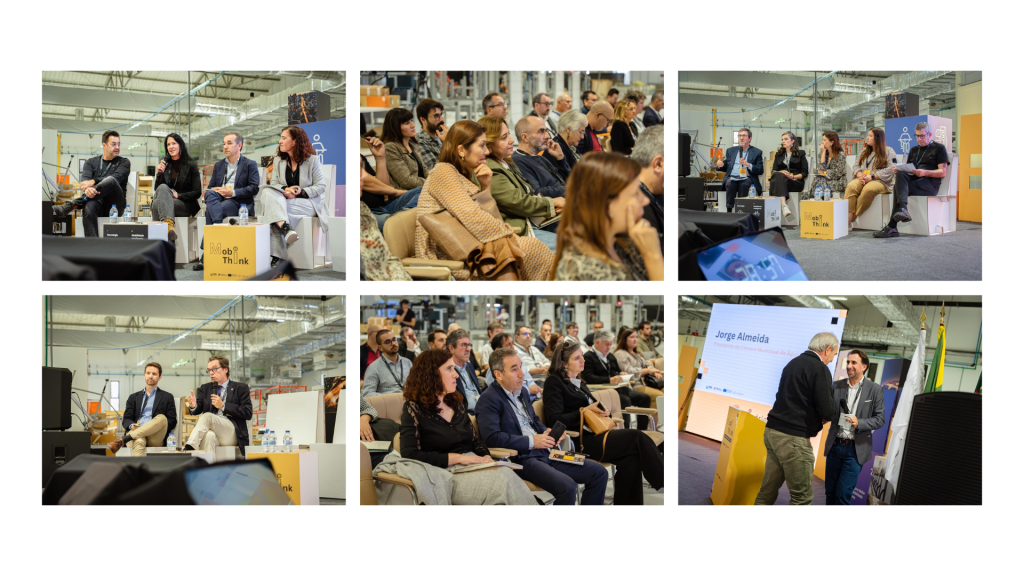
BIKiNNOV presents urban mobility study and launches book on the Smart Cities of the Future
Seminar held in Águeda brought together experts, researchers, businesses and public authorities to discuss the challenges of sustainable mobility and present contributions towards the development of smarter, more inclusive and sustainable cities.
On 28 October, BIKiNNOV – Bike Value Innovation Center Association hosted the Final Seminar – Smart Cities of the Future at its premises in Águeda. The initiative brought together national and international experts, business representatives, researchers and public authorities to jointly reflect on the challenges and opportunities of urban mobility and the transformation of cities.
The event marked the culmination of research carried out by BIKiNNOV under project 004ANI – Smart Cities of the Future, part of the Interface Mission – Core Funding for Technology and Innovation Centres. It provided an opportunity to present the main results achieved and promote knowledge-sharing among the various stakeholders in the mobility ecosystem.
Throughout the afternoon, discussions addressed key issues shaping the future of cities, ranging from sustainable urban mobility and carbon neutrality to the use of data, artificial intelligence and innovative solutions for more efficient urban management.
The programme featured Professor Gonçalo Homem de Almeida Correia, from Instituto Superior Técnico in Lisbon, who addressed sustainable urban mobility and carbon neutrality; Professor Miguel de Castro Neto, from NOVA Information Management School (NOVA IMS), who highlighted the role of data and artificial intelligence in smart city management; and Marta Alvarez, from EIT Urban Mobility, who shared perspectives on innovation, living labs (Living Labs) and active mobility in the cities of the future.
This was followed by a round-table discussion entitled “Mobility in the Cities of the Future”, moderated by Vitor Pereira, from the ZOOM Global Smart Cities Association. The panel brought together Ana Pereira, from Ubiwhere; Catarina Selada, from CEiiA; Cecília Silva, from the Faculty of Engineering of the University of Porto (FEUP); and José Eduardo de Matos, from the Intermunicipal Community of the Aveiro Region (CIRA).
The discussion brought together different perspectives on the challenges of urban transformation, highlighting the importance of cooperation between scientific research, technological development, public policy and the business community in developing more efficient, accessible and sustainable mobility solutions.
Book brings together knowledge and recommendations for the cities of the future
One of the highlights of the seminar was the presentation of the book “Integrating Active Mobility into the Cities of the Future”, a publication bringing together the results of research conducted by BIKiNNOV in collaboration with experts and various stakeholders from the sector.
The book is one of the project’s main outcomes, bringing together knowledge, technical contributions, reflections and strategic recommendations designed to support the integration of active mobility into urban planning and development.
The work presented stems from a research and collaboration process that included 12 MobiThinks sessions involving researchers, businesses, municipalities and other stakeholders in urban mobility. These sessions made it possible to identify challenges, analyse trends, share good practices and gather contributions towards solutions for smarter, more inclusive and sustainable cities.
Through this publication, BIKiNNOV aims to help disseminate and promote the knowledge generated, providing a basis for reflection and decision-making support for public authorities, businesses, researchers and professionals involved in the development of urban mobility.
Knowledge and collaboration driving urban transformation
The seminar reinforces BIKiNNOV’s commitment to research, technological development and knowledge transfer, fostering connections between the scientific community, the business sector and the authorities responsible for territorial planning and management.
By placing active mobility at the heart of discussions about the cities of the future, BIKiNNOV seeks to contribute to more sustainable urban models in which technological innovation, accessibility, efficiency and people’s quality of life play a decisive role.
The event was also attended by the Mayor of Águeda, Jorge Almeida, underscoring the importance of local authorities’ involvement in promoting innovative and sustainable solutions for their communities.
The initiative thus provided an opportunity to share the results achieved and strengthen collaboration among the different stakeholders, paving the way for new opportunities for research, innovation and cooperation in the field of urban mobility.
The Final Seminar – Smart Cities of the Future was held under project 004ANI – Smart Cities of the Future, part of the Interface Mission – Core Funding for Technology and Innovation Centres, funded by the PRR – Recovery and Resilience Plan and the European Union – NextGenerationEU.