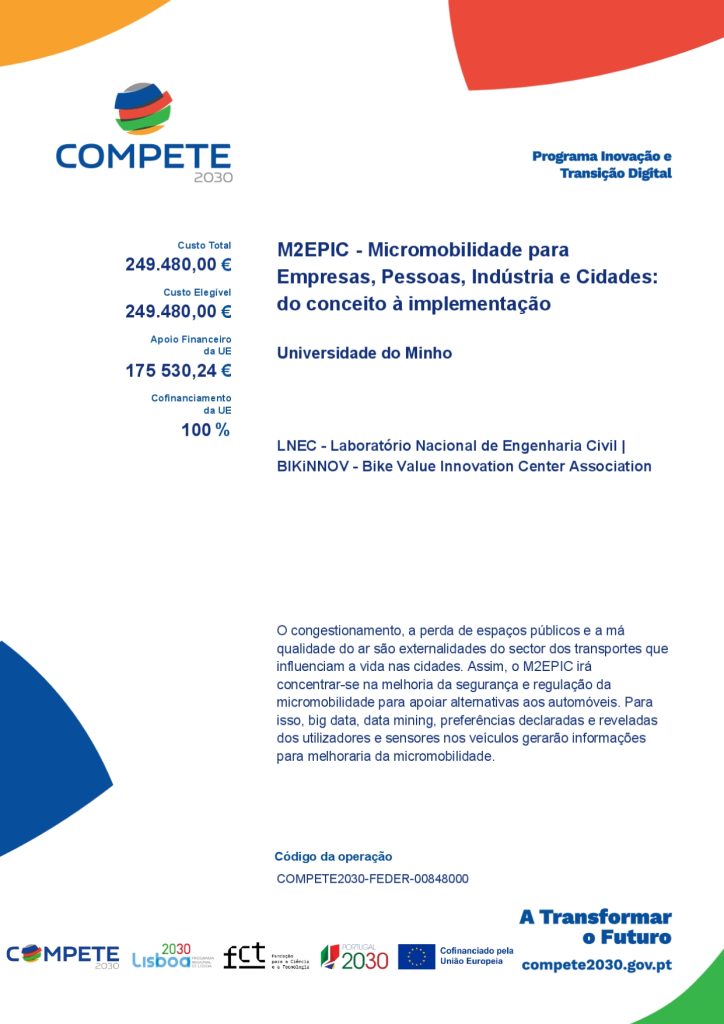
M2EPIC - Micromobilidade para Empresas, Pessoas, Indústria e Cidades: do conceito à implementação
PROJECT IDENTIFICATION
AND CONTEXT
Project Name: M2EPIC – Micromobilidade para Empresas, Pessoas,
Indústria e Cidades: do conceito à implementação
Operation Code: COMPETE2030-FEDER-008400
Fund: COMPETE 2030 – Programa Inovação e Transição
Digital
Beneficiary: Universidade do Minho
Partners: LNEC – Laboratório Nacional de Engenharia Civil |
BIKiNNOV – Bike Value Innovation Center Association
INVOLVED AMOUNTS
Total Cost:
€249,480.00
Eligible Cost: €249,480.00
EU Financial Support: €175,530.24
EU Co-financing Rate: 100%
OBJECTIVE(S)
The M2EPIC project aims to improve and
regulate micromobility as an alternative to car-based transport, contributing
to the reduction of congestion, the optimization of public space, and the
improvement of the quality of externalities generated by transport systems in
urban areas.
The project will focus on the use of big
data, data mining, and declared and revealed preferences of users and sensors
installed in vehicles, generating information to support the improvement of
micromobility.
PROJECT SYNOPSIS
Congestion, the loss of public space, and
the poor quality of externalities generated by transport systems have a
significant impact on life in cities. In this context, M2EPIC seeks to develop
knowledge and tools that support safer, more efficient, and better-regulated
micromobility solutions.
By collecting and analysing mobility data,
user preferences, and information generated through vehicle sensors, the
project will contribute to a better understanding of micromobility patterns and
needs, supporting decision-making processes and the implementation of more
sustainable urban mobility strategies.
PROJECT DESCRIPTION AND OBJECTIVES
M2EPIC – Micromobility for Companies,
People, Industry and Cities: from concept to implementation – is designed to
respond to current challenges in urban mobility, particularly those related to
congestion, public space management, and the environmental and social impacts
of transport systems.
The project will explore data-driven
approaches, including big data and data mining, as well as user preference
analysis and sensor-based information, to generate insights that can support
the development, regulation, and improvement of micromobility systems.
Through the collaboration between
Universidade do Minho, LNEC and BIKiNNOV, M2EPIC aims to contribute to the
implementation of more sustainable, efficient and user-oriented micromobility
solutions, supporting cities, companies, industry and citizens in the
transition towards improved mobility models.