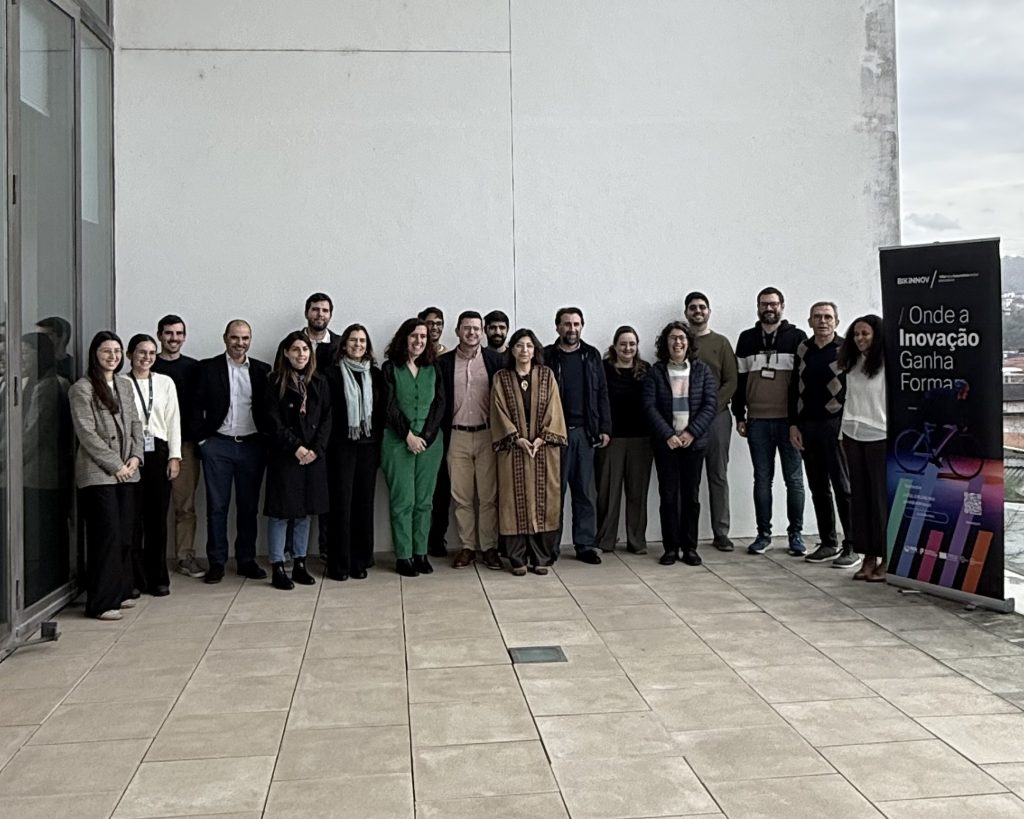
BIKiNNOV brings the third stage of its Roadshow to the University of Coimbra, focusing on biomechanics and safe robotics.
The University of Coimbra hosted the third session of the “From Research to Market” initiative, dedicated to exploring scientific and technological expertise with potential applications in the soft mobility industry.
On 20 November, the University of Coimbra (UC) hosted the third stage of the BIKiNNOV Roadshow – “From Research to Market”, dedicated to the theme “Biomechanical Integration and Safe Robotics”. The event continued an initiative that has been travelling across different Portuguese universities, with the aim of bridging the gap between scientific knowledge and the innovation needs and opportunities of the two-wheel industry.
Following the sessions held at the Faculty of Engineering of the University of Porto (FEUP) and the University of Beira Interior (UBI), the Coimbra stage highlighted research areas of growing relevance to the future of mobility, particularly in the development of intelligent systems, human-machine interaction technologies and solutions that promote safer, more efficient mobility tailored to users’ needs.
The opening session featured Professor Sandra Carvalho and David Macário, Executive Director of BIKiNNOV, marking the beginning of a programme focused on leveraging scientific and technological expertise and identifying potential synergies between academic research and the business sector.
During the morning, David Macário introduced BIKiNNOV, highlighting its main areas of activity, technological capabilities and the role it plays as a Technology and Innovation Centre in supporting the soft mobility industry.
The programme also featured presentations from several research units at the University of Coimbra, namely CITTA – Research Centre for Territory, Transport and Environment, CEMMPRE – Centre for Mechanical Engineering, Materials and Processes, CISUC – Centre for Informatics and Systems of the University of Coimbra, and ISR-UC – Institute of Systems and Robotics of the University of Coimbra.
These presentations were delivered by Professor Anabela Ribeiro, Professor Marta Oliveira, Professor João Macedo and Professor Gustavo Bongioví, respectively, showcasing the diversity of expertise and research areas within the institution.
The combination of these fields of knowledge is of particular interest to the two-wheel industry, opening up new opportunities for the application of emerging technologies in areas such as human-machine interaction, motion analysis, user safety, materials and manufacturing processes, and the development of intelligent mobility systems.
From knowledge sharing to creating opportunities
One of the key moments of the initiative was the co-creation workshop, designed to encourage collaborative reflection on the application of scientific expertise to specific challenges facing the sector. Through this collaborative approach, the aim was to bring together different perspectives and areas of specialisation, exploring opportunities for cooperation and the development of technological solutions with potential industrial applications.
During the afternoon, which was reserved for invited participants, the programme focused on direct engagement with the scientific infrastructure of the University of Coimbra through laboratory visits, meetings and technical discussions.
As part of the CITTA programme, visits were scheduled to the HcMR-lab – Human-Centered Mobile Robotics and the SPM Lab – Soft and Printed Microelectronics, providing participants with an insight into research areas related to human-centred robotics and flexible and printed microelectronics technologies.
The programme also included a welcome session led by Professor Aníbal Traça de Almeida, Director of ISR Coimbra, and a visit to the CEMMPRE laboratories, providing further insight into scientific and technological expertise relevant to industrial development and innovation.
A journey towards closer collaboration between research and industry
The third stage of the BIKiNNOV Roadshow built on the work carried out during previous sessions, introducing new areas of knowledge and technological perspectives relevant to the evolution of soft mobility.
From the exploration of cyber-physical systems and urban geometry at FEUP, through circular cycling and clean technologies at UBI, to biomechanical integration and safe robotics at the University of Coimbra, the initiative has been highlighting the diversity of scientific and technological expertise within the Portuguese scientific ecosystem and its potential applications in the two-wheel industry.
Through these events, BIKiNNOV seeks to foster increasingly close collaboration between universities, research centres and companies, encouraging knowledge sharing, the identification of common challenges and the development of collaborative opportunities.
The Coimbra stage represents another step in this journey towards closer collaboration between science and industry, reinforcing BIKiNNOV’s commitment to knowledge valorisation and the promotion of research, development and innovation projects capable of contributing to the sector’s competitiveness and technological advancement.
The initiative is being developed under Action Line 5 – Promotion and Networks, as part of the Interface Mission – Base Funding for Technology and Innovation Centres, funded by the Recovery and Resilience Plan (PRR) and the European NextGenerationEU funds.
For further information, please visit: https://recuperarportugal.gov.pt