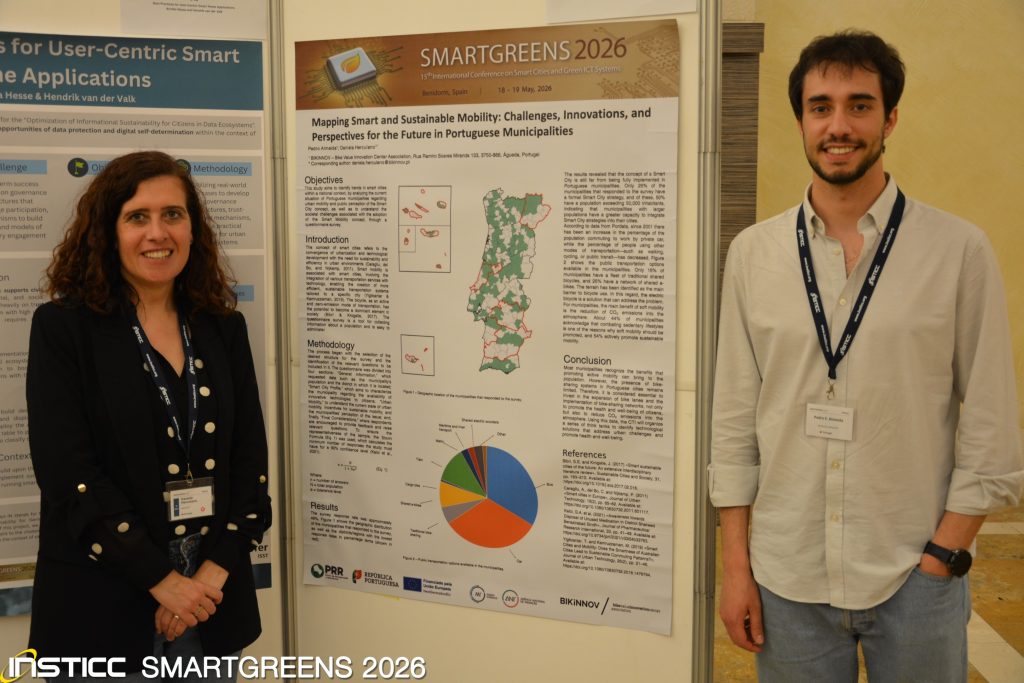
BIKiNNOV presents study on sustainable mobility at SmartGreens 2026
BIKiNNOV participated in SmartGreens 2026 – International Conference on Smart Cities and Green ICT Systems, held on May 18 and 19 in Benidorm, Spain, where Daniela Herculano and Pedro Almeida presented the paper “Mapping Smart and Sustainable Mobility: Challenges, Innovations, and Perspectives for the Future in Portuguese Municipalities”.
The study, comprehensive in nature, analyzes not only the national reality but also the main international trends in smart mobility, placing Portuguese municipalities within a global context of urban transformation. The analysis focuses on the challenges, innovative solutions, and future perspectives of intelligent and sustainable mobility, with particular emphasis on the integration of active mobility into the smart cities of the future.
Among the main findings, the study highlights the growing importance of active modes of transport, such as cycling and pedestrian mobility, as essential pillars for urban decarbonization, as well as the need to strengthen the integration between infrastructure, public transportation, and digital solutions. The study also underlines the decisive role of data, technological interoperability, and integrated urban planning in building more efficient, inclusive, and sustainable mobility systems.
By framing these conclusions within international trends, the work makes a significant contribution to the global debate on greener, smarter, and people-centered cities, highlighting concrete opportunities for development and evolution in Portuguese municipalities.
Through this participation, BIKiNNOV reinforces its commitment to applied research, innovation, and sustainability, consolidating its position as an active agent in the transformation of urban mobility.
This mission is part of project 004ANI – Smart Cities of the Future, developed under the Interface Mission – Base Funding for Technology and Innovation Centers, financed by the PRR – Recovery and Resilience Plan and by the European NextGeneration EU Funds.